ÖBB Railjet /1 – Overview

Passenger train servicesMain line services / Ticketing • Intercity • Austria • OBB • Railjet

Summary: ÖBB Railjet is not a subsidiary or a company in its own right, but the mainline brand of ÖBB for day trains. ÖBB uses the acronym ‘jet’ for all its services: ÖBB Cityjet (S-Bahn and regional services), ÖBB Nightjet (night trains) and ÖBB Railjet (mainline day trains). The terms ‘Intercity’ and ‘Eurocity’ are no longer used, with the exception of certain international trains that do not fall under the ‘jet’ concept. During 2005-2006, the idea of renewing the Intercity concept was considered from the angle of renewal and standardisation, with 7-car block trains pulled or pushed by a single locomotive. The ÖBB drew on its fleet of Taurus 1016 and 1116 series and gave the trains a new, highly successful design. ÖBB Railjet is one of several operators to have purchased new rolling stock.

➤ Similar operators: Acela – Avanti West Coast – Flixtrain – LNERLumoWESTbahn

Note: For educational purpose only. This page is meant purely as a documentation tool and has no legal effect. It is not a substitute for the official page of the operating company, manufacturer or official institutions. It cannot be used for staff training, which is the responsibility of approved institutions and companies.

Share this page   
Follow Us on    Follow Us on       


In brief

Railjet is – since 2005 – a registered trademark belonging to ÖBB Personenverkher, the passenger subsidiary of the Austrian ÖBB group. The idea came from an in-house marketing workshop whose moderator, the head of a communications company, registered the name a few days later! ÖBB had to pay 180,000 euros to get it back…

As part of its restructuring, the ÖBB Group had set itself the objective of increasing its competitiveness. The basic idea was to renew the rolling stock of the Intercity and Eurocity, long-distance trains that run on an hourly timetable, a concept that has been tried and tested by the Austrian state-owned company. It was also necessary to make a lasting impression with a strong identity celebrating the novelty and dynamism of the public company, since Europe was authorising competition in the long-distance segment by 2010. Finally, the Intercity, Eurocity and Express brand names had to be put in order, and rolling stock and on-board services had to be standardised as far as possible.

Caracteristics

Operator: ÖBB-Personenverkehr AG
Subsdiary / Division: 100% ÖBB Holding 
Sector: Passengers
Commercial segment: Main Line
International Transport: yes
First services: december 2008
Type of train : pushed/pulled trainset
Manufacturer(s) : Siemens
Traction : ÖBB
Official website : Railjet.com
Social media

In the meantime, the idea of speeding up journey times on the Vienna-Salzburg line was gaining ground. It was planned to run the fastest trains at up to 230km/h on a short stretch of almost 50 kilometres in Lower Austria, which does not make it a high-speed line in the true sense of the word. Nevertheless, the ÖBB Personenverkher division is incorporating this maximum speed into the specifications for the new rolling stock. Locomotives are not part of the project.

Routes
➤ RJX Budapest / Bratislava – Vienna Hauptbahnof – Linz – Salzburg – Munich Hbf
➤ RJX Vienna Airport – Vienna Hbf – Linz – Salzburg Hbf – Innsbruck – Feldkirch – Bregenz
➤ RJX Vienna Airport – Vienna Hbf – Linz – Salzburg Hbf – Innsbruck – Feldkirch – Zürich Hbf
➤ RJ Vienna Hbf – Klagenfurt – Villach – Udine – Venice
➤ RJ Graz – Mürzzuschlag – Vienna Hauptbahnof – Breclav – Brno – Pardubice hl.n. – Praha hl.n.
➤ RJ Graz – Mürzzuschlag – Wiener Neustadt – Wien Meidling – Vienna Hbf – Vienna Airport
➤ RJ Vienna Hbf – St.Pölten – Linz – Wels – Attnang-Puchheim – Salzburg Hbf
➤ RJ München Hbf – Rosenheim – Innsbruck Hbf – Bolzano/Bozen – Trento – Verona Porta Nuova
➤ … (many others, see details at this page)

Rolling stock (past and present)
First generation
Siemens Viaggio + Taurus
2008 – …


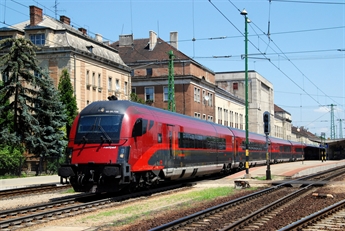
The first generation of Railjet vehicles was designed to be propelled in push-pull mode by standard electric locomotives, specifically the ÖBB Class 1116 Siemens ES64U2 and ÖBB Class 1216 ES64U4. These are 7-car block trainsets and the pilot car has the same design as the Taurus locomotive.


Second generation
Siemens Viaggio + Vectron
2024 – …


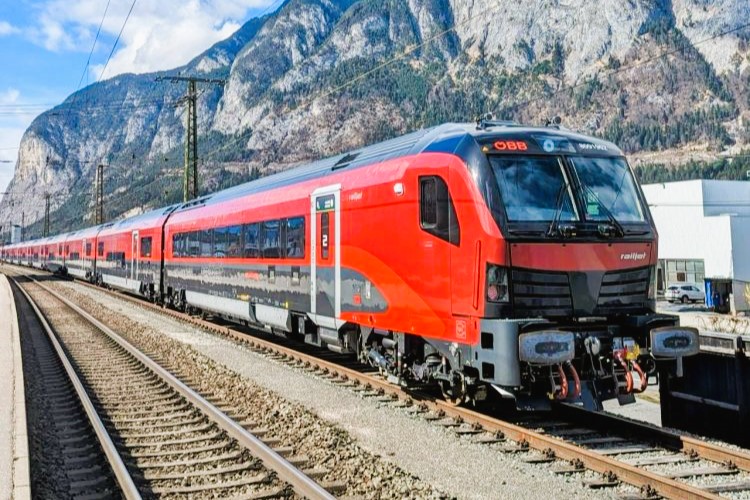
The second Railjet trainsets generation consists of carriages also from the Siemens Viaggio Next Level platform and is usually pulled or pushed by a Vectron locomotive. These are 7-car block trainsets and the pilot car has the same design as the Vectron locomotive. For the first time, low-floor entrances are available in some carriages.

KISS
Stadler
2026 – …


The ÖBB will be using Railjet double-decker trains for the first time from spring 2026. 14 double-decker trainsets for the regional long-distance Railjet service have been ordered from the Swiss manufacturer Stadler. Railjet will use them on selected RJs with more frequent stops.


We will now go into more detail below and on the following pages.


The general concept

Lightweight, high-comfort reversible push/pull trainsets with 7 carriages: 2 first-class carriages, a restaurant carriage and 4 second-class carriages, i.e. 185.5 m for 330 tonnes. Each trainset and its locomotive can be coupled with a second trainset. The trainsets had to offer much greater comfort and lower production costs. No unnecessary shunting: one end is fitted with a pilot car, allowing reversibility. To achieve this, the locomotives have to be permanently connected to the trainsets, which saves on headway costs, the most important of which are the network usage charge, the working hours of the train drivers and traction services such as washing and maintaining the trains. ‘We hope to save one hour of work per day and per train, or 100 euros’, explained a manager in 2008.

The trains should be able to operate in Germany, Switzerland, the Czech Republic and Hungary. Comfort is available in three classes: Economy class, First class and Premium class, which is a first on the Austrian network.

The winner of the bid
Bids from Bombardier, Siemens and CAF were accepted by ÖBB management in 2005, and at a Board meeting on 9 February 2006, the Supervisory Board of ÖBB-Holding approved the purchase of 23 trainsets worth €245 million, with an option to deliver a further 44 sets up to the end of 2006.

Design and livery
The livery to be adopted is of paramount importance: the aim is to make a mark, to break with the long Intercity / Eurocity period. The Spirit Design agency in Vienna was responsible for the branding. Three different designs were selected and put to the vote by ÖBB customers. In March 2007, two locomotives were selected in the Linz workshops, 1016 034 and 035, simply because they were there for routine maintenance. A third locomotive, 1116 200, had to return to the workshop to have its ‘Semmering 200’ promotional lamination removed. The opportunity was taken to give it the third version of the design. The three machines thus came out with three different liveries, as shown in the photos below.
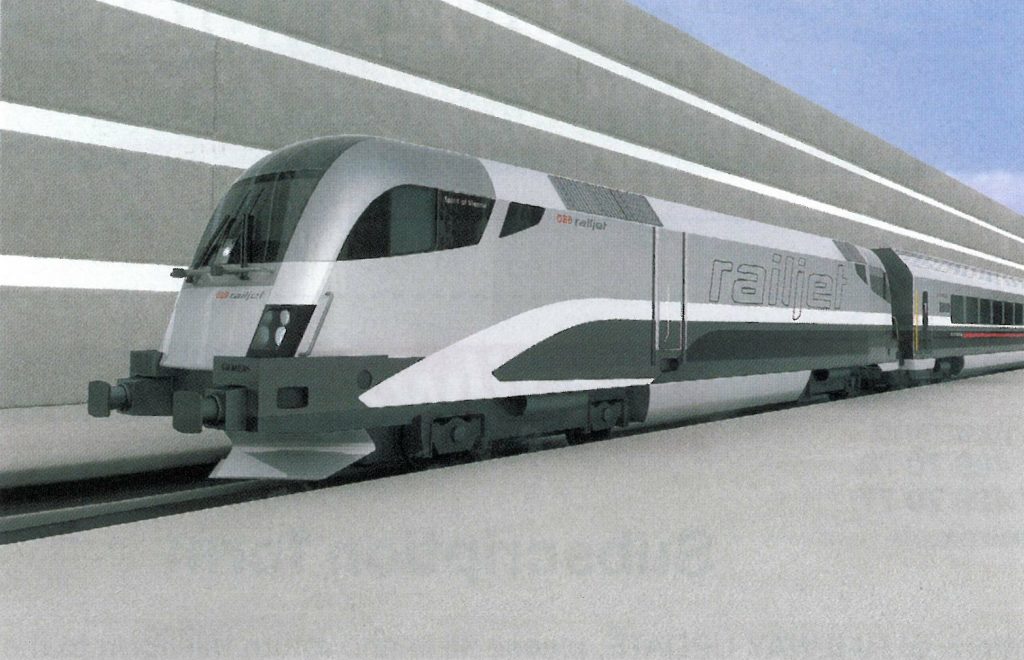

Each of the locomotives had a baptismal name: Spirit of Salzburg, Spirit of Linz and Spirit of Wien. Both 1016 034 and 035 had been given a grey base livery. On the 034, a gradient of grey and a white stripe adorned the lower half of the body. On the 035, the white was replaced by red. The ‘Railjet’ logo was grey on the 034, white on the 035, both with a discreet ‘ÖBB Railjet’ under the roof near the driver’s cabs. These machines ran on various Intercity routes, taking them as far as Busch on the Swiss border.

The liveries of the 1016 034 and 034 presented to the general public, marked ‘ab 2008’ (from 2008). These machines travelled at the head of various Intercity and Eurocity trains throughout the country. (photo Martin Radner via wikimedia)

The 1116 200, meanwhile, sported a different livery. Its basic colour was the very elegant burgundy red, on which the grey gradient and red stripe of the 1016 035 had been used.

The Austrian tabloid ‘Krone’ then carried out a two-month poll on its website where its readers could vote for the future Railjet design, an unprecedented move on the part of a public railway company. On 19 May 2007, the results showed the design of the 1116 200 topping the poll, followed by the 1016 035 and finally the 1016 034. The most popular design was inevitably used on all the coaches. The ‘Railjet’ design was born…
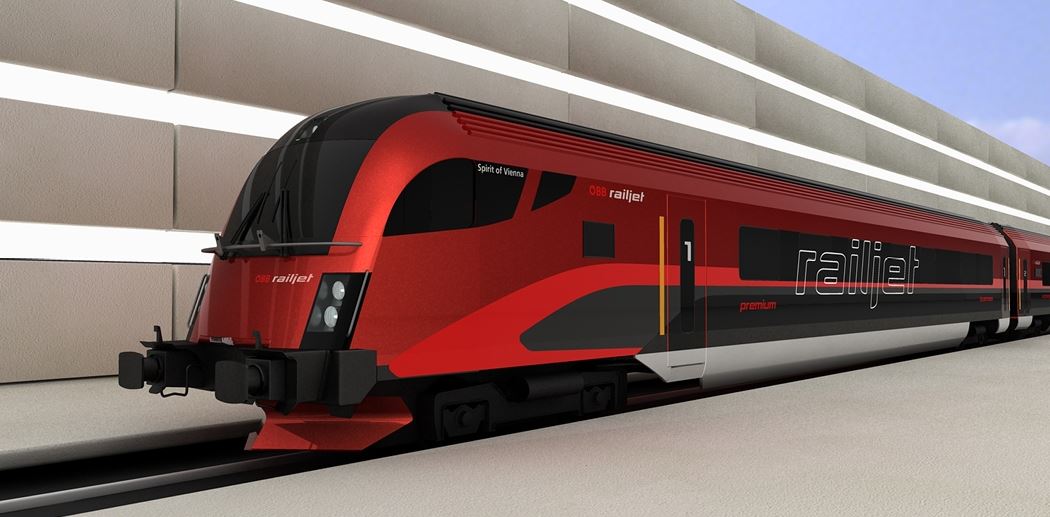
(photo ÖBB)

Spirit Design is the agency responsible for the entire interior and exterior design of the Railjets. Tones, colours and choice of materials have been carefully studied, in the knowledge that design plays an important strategic role. Not only does it have a visual function, it also conveys specific messages and creates added value for passengers. The agency’s innovation model, which integrates strategy, product and brand, was used successfully in this project. Some of the elements of the Railjet train design study are shown opposite.


(photo ÖBB)

According to the agency, the exterior and interior design of the ÖBB Railjet project is about much more than aesthetics. The design must fulfil important communication functions: the aim is to attract target groups to the train by combining concrete elements of safety, comfort, speed and high technology. The Railjet’s design research had to differentiate it from other modes of transport and offer passengers added value. “The new Railjet is unique in ÖBB’s history. We found the right partner in Spirit Design, which has extensive experience in all areas of application. In addition to appearance, the agency is also able to look at technical issues, material decisions, etc.“, explained Rupert Marl, ÖBB Railjet Project Manager at Personenverkehr AG on the agency’s website.

(photo ÖBB)

Colours play an important role in the subjective and individual perception of human beings. Seen from the outside, the ÖBB Railjet evokes associations of dynamism and speed. An impression that is reinforced by the distinctive lettering on both sides of the train. Inside, the only colours used are white, anthracite and silver, derived from selected materials. Above, red accents are used selectively. Slightly coloured indirect lighting elements in the various equipment variants complete the pleasant atmosphere of the railjet. Every detail had to be considered, right down to the interior doors. This is shown in the illustration below.

This design won several awards: in 2008, it was nominated for the Createch Award, presented by the Austrian Federal Ministry of Transport, Innovation and Technology. In 2009, it received the ‘Gute Gestaltung’ award from the German Designer Club and the ‘Red Dot’ quality label from the Designzentrum Nordrhein-Westfalen. The Railjet design was also nominated twice for the German Design Prize (2009 and 2010) and again for the Austrian Design Prize (2009). It was also awarded the ‘Consumer Favorite 09’ prize at the Universal Design Award, which was announced by the iF Designforum in Hannover. Clearly the ÖBB had achieved a master stroke in railway branding…
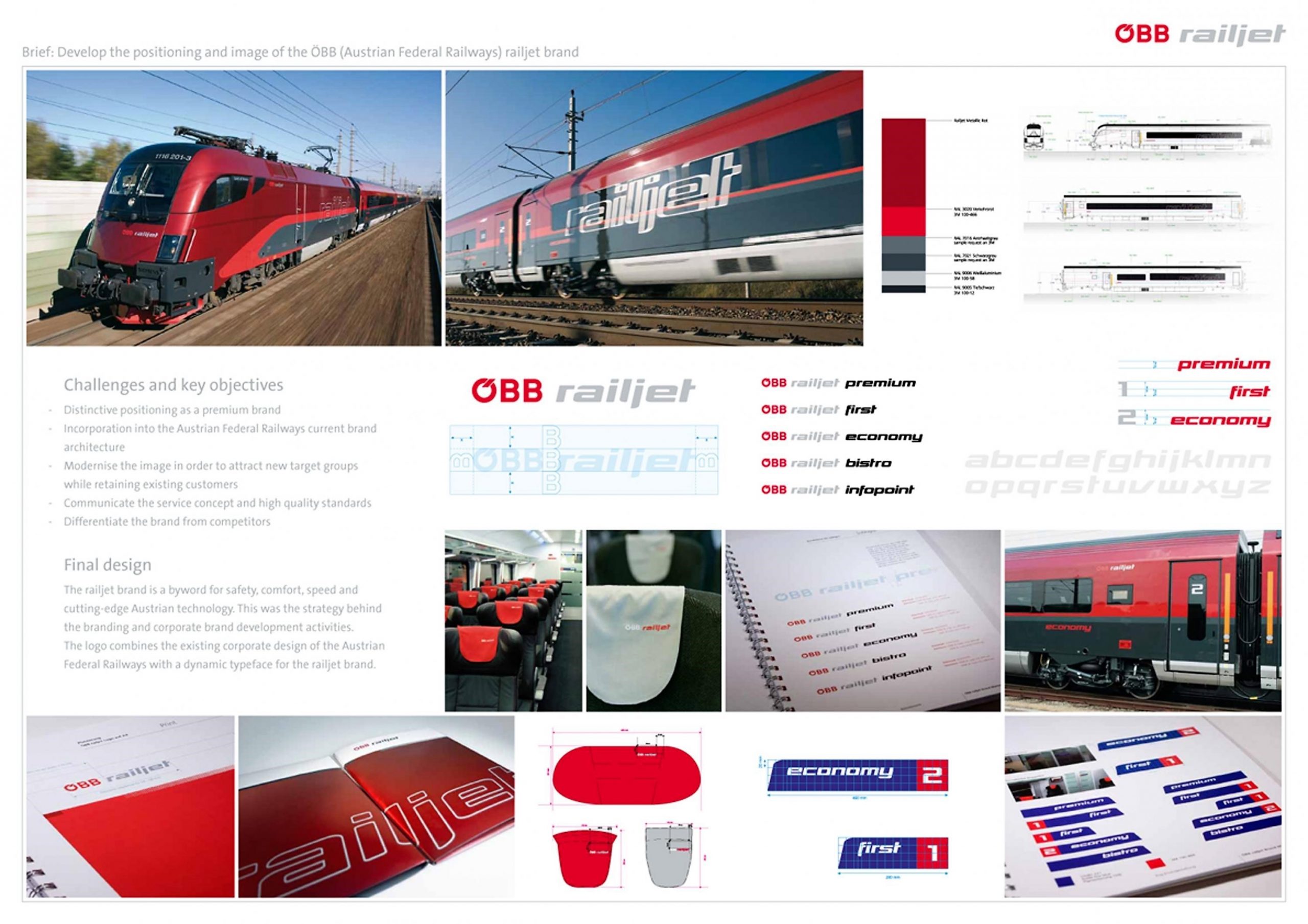
(photos ÖBB)


2008 – The launch

The Railjet, ÖBB’s flagship high-speed train, was officially launched on 14 December 2008 with the start of the new timetable. The inaugural services connected Vienna with Munich and Zurich, replacing traditional EuroCity trains on those key international corridors.

The novelty lay in the use of 7-car trainsets pulled/pushed by Taurus Class 1016/1116 locomotives. This enabled ÖBB to compose a train with two trainsets – i.e. 14 cars – to relieve pressure on shared routes or simply increase seating capacity.

With this move, ÖBB took a different path from its neighbours, operating trains with locomotives rather than multiple units like the German ICE or Trenitalia’s Frecciarossa. The Czech railways CD adopted the same idea as ÖBB, using identical rolling stock to operate a service between Graz, Vienna and Prague.

2011: face to concurrence

On 11 December 2011, the first WESTbahn trains began a new adventure on the mainline segment in Austria, between Vienna and Salzburg.

WESTbahn GmbH is an Austrian railway company founded in 2008 and is a 100% subsidiary of Railholding AG. The name WEST is not derived from the Vienna-Salzburg line, which bears the historic name of Westbahn, but from the four letters of the founder, WEhinger STefan, a former executive of the state-owned ÖBB.

On 30 June 2009, a framework agreement on the allocation of infrastructure capacity for the years 2011 to 2016 was signed between WESTbahn and ÖBB Infra. From the outset, the aim was to offer an hourly service between Vienna and Salzburg. It was therefore clear that WESTbahn was here to stay, which disrupted the ÖBB’s business model.

Despite a ruthless price war with the ÖBB, WESTbahn gradually managed to carve out a place for itself on the Austrian market, while remaining confined to the Vienna-Salzburg route.

👉 See our specific page about WESTbahn

ÖBB’s Railjet reacted on several fronts in 2012–2013.

• First, timetables: ÖBB reshuffled services on the Weststrecke, cutting some trains but maintaining the core half-hourly Railjet/InterCity pattern between Vienna and Salzburg.
• Second, pricing: to counter WESTbahn’s roughly half-fare walk-up price, ÖBB pushed comparable promo fares (e.g., Sparschiene-style limited-quota offers) to the general public, though only in restricted numbers.
• Third, service features: WESTbahn’s free Wi-Fi nudged ÖBB to begin introducing Wi-Fi on (some) Railjets during 2012, narrowing the onboard amenity gap.
• Fourth, legal/regulatory skirmishes: disputes erupted over access and information display; proceedings about timetable/real-time data and station promotion practices ran through regulators and courts.

A case before Austria’s competition authority concluded with a settlement that became final in late February 2013.

2017-2018 – A second generation to expand

ÖBB introduced the distinction between Railjet (RJ) and Railjet Express (RJX) in December 2017, with the timetable change.

  • RJX = express trains, with fewer intermediate stops (e.g. Wien – Salzburg – Innsbruck – Zürich or Wien – München, running faster).
  • RJ = “regular” trains, serving more intermediate stations along the same routes.

In 2018, WESTbahn doubled its frequencies. Adding the half-hourly service provided by ÖBB Railjet on the Vienna-Linz-Salzburg route, this resulted in a comprehensive rail service with trains running every 15 minutes throughout the day.

In 2018, ÖBB has selected Siemens Mobility to supply new inter-city rolling stock following the close of bidding on June 29 and subsequent evaluation completed by July 20. The agreement, subject to a 10-day standstill period, covers the design and construction of eight daytime trainsets and 13 overnight sets, valued at €375 million. This marks the first drawdown under a broader framework contract.

The new feature is the adoption of a nine-car train set, which will replace EuroCity stock on services to and from Italy, where stricter fire regulations from 2021 prevent the use of existing vehicles. The overnight stock will expand and modernize ÖBB’s Nightjet fleet, which currently includes sleeping and couchette cars inherited from Deutsche Bahn’s withdrawn City Night Line service in 2016.

Tendering was delayed last year after Austria’s federal administrative court intervened following Siemens’ complaint about late specification changes. Siemens is offering Viaggio-derived Railjet designs, while Bombardier proposed aluminium-bodied alternatives with Chinese components.

2020 – The pandemic

In March 2020 response, as Austria went into its first lockdown, ÖBB sharply cut long-distance Railjet frequencies and halted most cross-border services. From March 23, 2020 ÖBB switched to a weekend/Sunday-style timetable, which specifically included fewer Railjet trains on Vienna–Salzburg, Vienna–Innsbruck and Vienna–Villach; Italy-bound services had already been suspended around March 11.

The Ministry for Climate Action (BMK) used emergency Public Service Obligation (PSO) contracts to guarantee a basic long-distance offering on the key Vienna–Salzburg corridor, shared between ÖBB and WESTbahn:

  • Apr 20–mid-July 2020 (initial 3 months): Emergency PSO, each operator running one train each way every two hours (a coordinated reduced service).
  • Extensions through Oct 7, 2020: The PSO was extended, with an agreed hourly pattern (RJX hourly; RJ and WESTbahn alternating hourly) and mutual ticket acceptance to keep capacity and connectivity stable.
  • Nov 16, 2020–Feb 7, 2021: a further €45 million emergency contract ensured continuity over winter as demand remained depressed.

In early 2021: The emergency PSO contract that started in November 2020 (worth €45 million) ran through February 7, 2021, keeping ÖBB Railjet and WESTbahn running on Vienna–Salzburg despite very low ridership.

Spring 2021: As restrictions eased and travel demand returned, both operators gradually increased service frequency. WESTbahn resumed more of its open-access pattern, and ÖBB restored Railjet/X services, though international routes (to Italy, Germany, Czechia, Hungary) were still partially curtailed until border rules relaxed in stages.

Second half of 2021: By summer, Austria–Germany and Austria–Czech Republic Railjet services were running again, and the Vienna–Salzburg corridor was essentially back to pre-pandemic frequencies. Government PSO support was not extended further—operators carried the risk again once demand stabilized.

2022-2024 – Back to normal services and expansion

By 2022, Railjet had fully reinstated its long-distance network, including cross-border services (Germany, Switzerland, Czech Republic, Hungary, Italy) as travel restrictions were lifted across Europe.

Demand recovery was strong: ÖBB reported record passenger numbers in 2022, surpassing even 2019, especially on Vienna–Salzburg Railjets, showing that passengers quickly returned once restrictions disappeared.

The Austrian government no longer relied on emergency PSO contracts but continued its regular PSO agreements for regional trains. Long-distance open-access competition between ÖBB Railjet and WESTbahn resumed under normal market conditions.

Following a two-tier policy, the RJ and RJX, ÖBB’s offering has been expanded with a new type of train featuring double-decker railcars, intended for Railjets RJ, which make slightly more stops than RJX, which remain pulled/pushed by trainsets.

The €600m firm order for 35 Kiss EMUs signed on July 6 2023 has been placed as the first option under a 2022 framework agreement covering up to 186 trains, and takes the total ordered so far to 76. The first EMUs from the initial order are scheduled to enter service in eastern Austria from mid-2026.

Start of deployment of Railjets NG
With delays due to the pandemic, ÖBB has introduced in March 2024 its second-generation Railjet NG trainsets on Wien–Feldkirch services during Easter. An other international inaugural run took place on April 5, 2024, on international routes between München Hbf and Verona via the Brenner corridor, with regular service starting April 8. The deployment of 9-car Railjets then continued throughout the year.

2025-2026 – More Railjets rather than Nightjets

ÖBB’s head of long-distance trains, Kurt Bauer, has cautioned that night trains remain a “niche product” and urged Deutsche Bahn (DB) to leave the market to Austria. His remarks to the Tagesspiegel followed ÖBB’s decision to cut its Siemens Nightjet order from 33 to 24 sets, redirecting investment to its more profitable Railjet 2 fleet.

Since taking over DB’s abandoned sleepers in 2016, ÖBB has grown Nightjet into Europe’s largest overnight network, reopening routes to Paris, Brussels and Amsterdam. But Bauer stresses the limits: delays quickly ruin connections, every carriage must pay its way, and dining cars have been scrapped for beds.

Despite strong demand, he calls sleepers “our business class”: never cheap, competing unfairly with untaxed aviation, and increasingly threatened by disruptive rail construction in Germany.

This is why Austrian rail operator ÖBB amended its rolling stock contract with Siemens Mobility earlier this year, limiting deliveries of new-generation Nightjets to 24 trains instead of the 33 originally planned. ÖBB has thus shifted its investment priorities towards Railjet 2 trains, citing a sharp increase in passenger demand and the need for additional daytime capacity. 🟧


Share this page   
Follow Us on    Follow Us on       


[TOP]
Main line • Intercity • Austria • OBB • Lexical

——————————————————————————————————————————————————————————————-