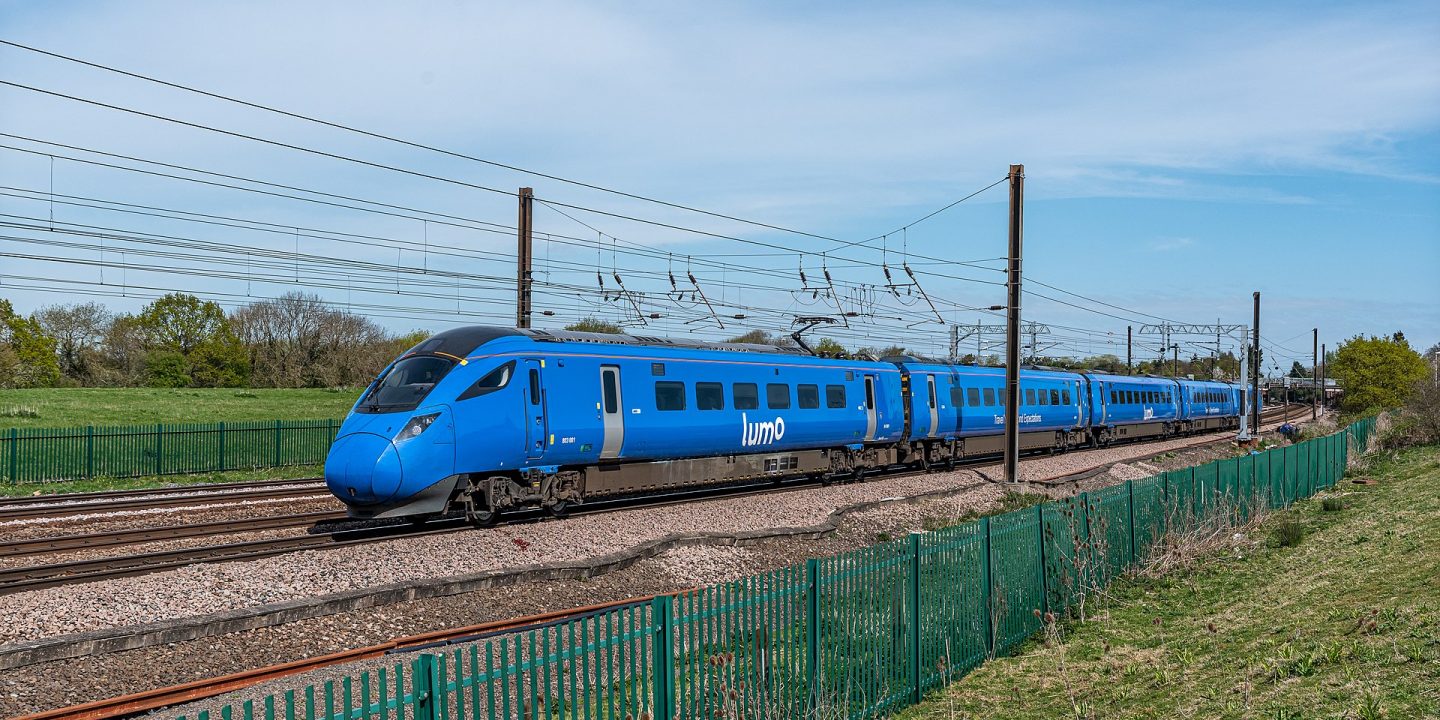
Main line • Intercity • Great-Britain • Lumo
➤ Similar operators: Acela – Avanti West Coast – Flixtrain – LNER – ÖBB Railjet – WESTbahn
Note: this page is for educational purposes only. It is not a substitute for the official page of the operating company or manufacturer.
👉 (Version française disponible)
In 2015, the UK regulator ORR – the Office of Rail and Road – launched a call for expressions of interest for an open access operation to tender for additional services on the East Coast line, allowing a new company to operate train services in addition to the existing franchise operator. The idea was to boost an important line that had been rather badly damaged at the time, when it was Stagecoach in partnership with Virgin that held a franchise that would later prove to be calamitous. The withdrawal of Virgin Trains East Coast was succeeded in June 2018 by LNER – London North Eastern Railway – a company owned by DfT OLR Holdings, i.e. the British State. This episode led to strong criticism of the franchising system and added to the curses hanging over this legendary East Coast line.
Operator: Lumo
Subsidiary / shareholders: First Group
Sector: Passengers transport
Type of service: Main line
International transport: no
First services: 25 October 2021
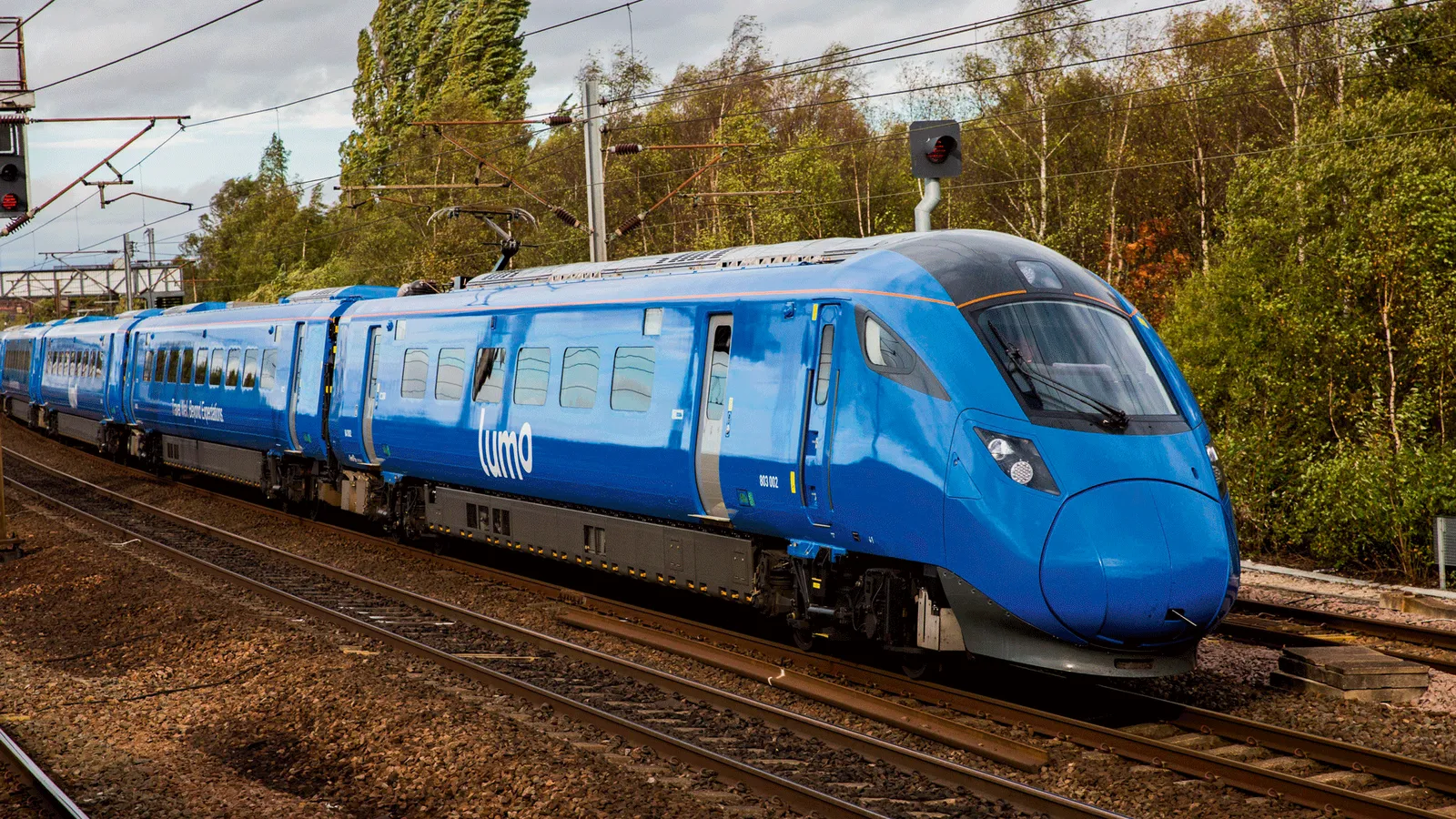
Train type: Hitachi Emu Class 803
Manufacturer(s): Hitachi Rail Europe
Driver service: own
Officiel website: https://www.lumo.co.uk/
Social media: :
Similar companies : Acela – Avanti West Coast – LNER – ÖBB Railjet – WESTbahn
In brief
Routes
➤ London King Cross – Stevenage – Newcastle – Morpeth – Edinburgh
Rolling stock (past and present)
Hitachi Rail
2021 – …
The start of activities
Since 2016, the British rail system had been feeling the pinch, with a future marked by Brexit, terrorist attacks (London, Manchester) and a shrinking economy. However, this did not stop FirstGroup from looking at projects beyond its five existing franchises. The operator already had solid experience in rail operations, and even experience of open access with its stake in Hull Train. So it wasn’t going into the East Coast venture blind…
In addition to its plans to take over from Virgin the lucrative services on England’s other iconic line, the West Coast, FirstGroup responded to the ORR’s call for expressions of interest, which in May 2016 awarded it a 10-year agreement to operate five trains a day in each direction between London and Edinburgh via the intermediate stations of Stevenage, Newcastle and Morpeth from 2021.
Initially, the subsidiary set up by First Group was called East Coast Trains. From the outset, the business model was centred on a low-cost, single-class service, like Flixtrain, SNCF’s Ouigo or Renfe’s Avlo. FirstGroup’s aim is to attract air passengers to rail, not to compete with Virgin or LNER. Two-thirds of journeys between Edinburgh and London are made by air. East Coast Trains plans to offer an average fare of less than £25 (€29) with new trains offering free Wi-Fi and on-board catering.
For its services, East Coast Trains planned to lease five Hitachi trains from the Azuma range, but arranged as single-class trains and with a shorter five-car length. From 2020, East Coast Trains’ mandate was to “reimagine rail”. East Coast Trains managing director Helen Wylde told Modern Railways that the company had hired Insight House to carry out customer research, which identified that the most important question to ask was why people travel. East Coast Trains’ ambition was to recommend a seat to prospective passengers based on their travel preferences, so that business travellers could enjoy a quiet environment in which to work, while groups of leisure travellers could be seated together in a different part of the train.
It pointed out that only 8% of people in the UK use trains regularly, and said the aim is to provide a greener, affordable and easy-to-use travel option. The company was making a £15 million (€17.6 million) investment in digitisation to become a paperless business. “Travelling in the UK shouldn’t cost a fortune and it certainly shouldn’t be the planet that pays. Whatever your preferred mode of transport, we’ll probably be more affordable and kinder to the planet. We believe that everyone has the right to travel in style. We give people the means to make truly affordable green travel choices without compromising on comfort.“
2021 – Launch of Lumo service
On 7 September 2021, an official presentation gave the name of the future service: Lumo, a brand name based on the concept of luminosity in motion. Lumo also presented its Hitachi trainset, a Hitachi Rail Class 803 ordered in March 2019 and financed by Beacon Rail Leasing Ltd under a £100 million, 10-year contract (€117 million). The actual departure was scheduled for the end of October.
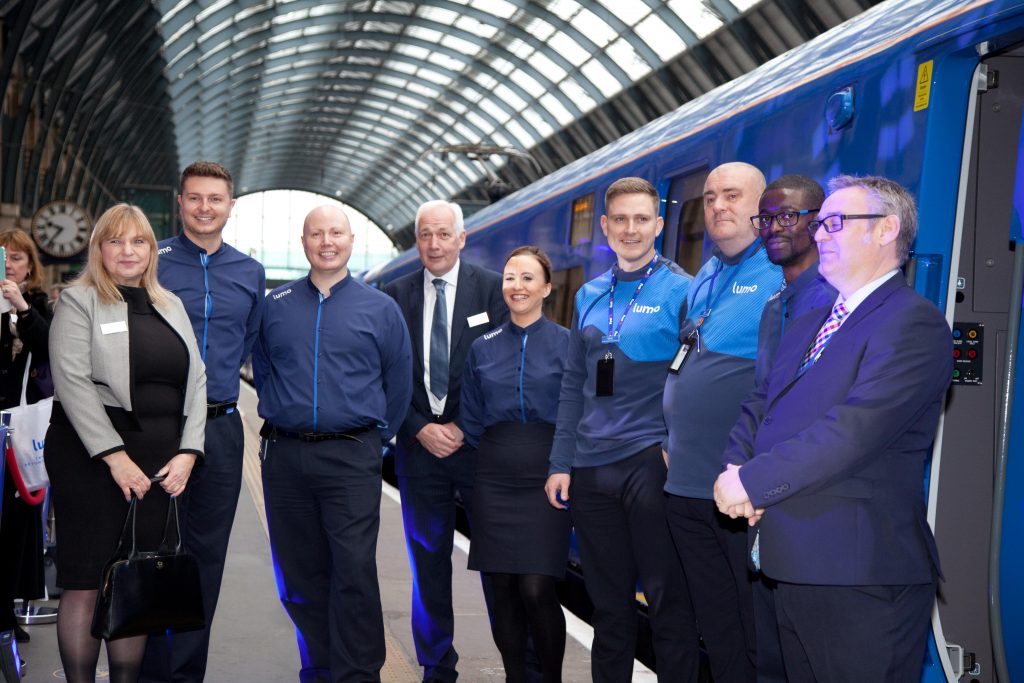
On 21 October 2021, the first Lumo preview train left London King-Cross for Edinburgh with passengers on board. Commercial service began on 25 October. Initially, two trains a day in each direction will run (one on Saturdays), with the ambition to increase this to four before Christmas and launch the full timetable in mid-February 2022. The staggered start to services is mainly due to the need for full driver training.
Lumo’s on-board staff are presented as “ambassadors”, not conductors or attendants. They have completed a 12-week training programme. Lumo has 90 on-board staff, all based in Newcastle, where the company is headquartered, and has set up an academy for in-house training. Lumo employs 30 train drivers, 5 of whom are instructors and half of whom are apprentices. The other 60 are on-board ambassadors, 45% of whom are women and 90% of whom are rail novices. Many come from sectors such as aviation and the hotel industry. Two ambassadors will be needed on each train service, as this role is essential for safety, although the doors are controlled by the driver. The ambassadors will be responsible for all aspects of on-board service, including revenue protection, catering and cleaning.
2024 – ‘There is a futur for open access in the new railway landscape in Britain’
This was the analysis of Phil Gilbert, Managing Director of FirstGroup’s open access subsidiaries, in an interview with Rail Business UK, who robustly defends the open access model in UK rail, exemplified by Hull Trains and Lumo. He highlights the increased service frequency and consumer benefits these operators bring. Gilbert addresses criticisms about capacity and costs, asserting that open access operators like Lumo and Hull Trains pay their fair share of infrastructure and station access charges. He acknowledges the new Infrastructure Cost Charge but insists open access operators do not disproportionately increase infrastructure costs.
Gilbert emphasizes the need for a reliable East Coast Main Line timetable and sees potential for additional Lumo services. Despite delays in timetable revisions due to industry concerns, he remains optimistic about future service expansions, including a new London-Sheffield route.
He also focuses on improving customer service, citing initiatives like dedicated support teams during disruptions. Gilbert appreciates FirstGroup’s substantial financial backing and independence for Hull Trains and Lumo, noting their efficient cost control and staff training programs.
Gilbert concludes that open access rail services foster regional growth without burdening taxpayers and should be seen as a successful example of private sector contribution to public railways.
Service expansion?
In January 2024, FirstGroup has submitted a preliminary application to the Office of Rail and Road (ORR) to introduce an open-access service between London Euston and Rochdale, potentially starting in 2027. The proposed service would run six return trips daily, stopping at Warrington Bank Quay, Newton-le-Willows, Eccles, and Manchester Victoria on the West Coast Main Line.
This service would reconnect Rochdale directly to London for the first time since 2000, facilitate access to Salford via Eccles with the Manchester Metrolink light rail, and improve connectivity for St Helens through Newton-le-Willows. FirstGroup aims to provide 1.6 million people in northwest England with a convenient and competitively-priced rail service to London, encouraging a shift from coaches and private cars to rail. FirstGroup CEO Graham Sutherland highlights the significant growth, economic, and environmental benefits observed with open access services. 🟧
[TOP]
Main line • Intercity • Great-Britain • Lexical