LNER (London North Eastern Railway) /1 – Overview

Passenger train services • Main line services / Ticketing • Intercity • Great-BritainLNER

Summary: London North Eastern Railway (LNER) is a British rail operator. It is owned by DfT OLR Holdings on behalf of the Department for Transport (DfT). The company’s name echoes that of the London and North Eastern Railway, one of the four major companies that operated between 1923 and 1948. In June 2018, LNER took over the InterCity East Coast franchise, after the previous private operator, Virgin Trains East Coast (VTEC), returned it to the government following ongoing financial difficulties. In the UK, in the event of problems with a franchise, an Operator of Last Resort (OLR) was available to take over the operation. This is the case of LNER which, since the disappearance of the franchise system, now manages all the mainline trains between London, York, Newcastle and Edinburgh. LNER is one of the operators that have purchased new rolling stock.

➤ Similar operators: AcelaAvanti West CoastFlixtrainLumoÖBB RailjetWESTbahn


Note: For educational purpose only. This page is meant purely as a documentation tool and has no legal effect. It is not a substitute for the official page of the operating company, manufacturer or official institutions. It cannot be used for staff training, which is the responsibility of approved institutions and companies.

Share this page   
Follow Us on    Follow Us on       

Key points

  • LNER was established in June 2018 after the previous private operator on the East Coast Main Line franchise returned it to the government. 

  • It is owned by DfT OLR Holdings on behalf of the Department for Transport, making it a publicly-owned operator of last resort. 

  • The fleet includes modern trains from Hitachi Rail (classes 800/801) and an order for tri-mode trains from CAF, to replace older rolling stock and support sustainability. 

  • LNER services cover the main route from London King’s Cross to York, Newcastle and Edinburgh (and beyond) and enjoyed a good success while the franchise policy collapsed.

Read the full package about LNER:

The company Rolling stock Train services Economics

In brief

The modern London North Eastern Railway (LNER) was established in June 2018, marking the rebirth of a historic name in British rail transport. Unlike its predecessor from the early 20th century, the new LNER was not formed through industrial consolidation but through a government intervention. The UK’s Department for Transport took the decision to bring the East Coast Main Line franchise back into public ownership after the collapse of Virgin Trains East Coast, a private operator that had struggled to meet its financial commitments.

The new company, officially called London North Eastern Railway Limited, began operating under the ownership of the Department for Transport’s holding entity, DfT Operator of Last Resort Ltd, which manages state-run train services when franchises fail.

Factsheet

Operator: LNER
Subsidiary / shareholders: 100% of DfT (Department for Transport)
Sector: Passengers transport
Type of service: Main line
International transport: no
First services: 2018
Train type: Hitachi “Azuma” Class 800/1 + 800/2
Manufacturer(s): Hitachi Rail
Driver service: In-house
Officiel website: https://www.lner.co.uk/
Social media:
Similar companies : Avanti West CoastLumo


Regular routes
➤ London King Cross – Doncaster – Leeds – Harrogate / Skipton / Bradford
➤ London King Cross – Doncaster – York – Middlesbrough
➤ London King Cross – Doncaster – York – Newcastle – Suderland
➤ London King Cross – Doncaster – York – Newcastle – Edinburgh – Aberdeen / Inverness / Glasgow

Rolling stock (past and present)

Intercity 125 (†)
BR workshops Crewe and Derby
1976 – 2019


HST 125s are a railway icon from Great Britain, and British Rail in particular. A success story that explains their longevity and the fact that, for a short period between 2018 and 2019, LNER had to operate them before switching to all-electric trainsets as shown bellow.


Intercity 225
BREL, GEC-Alsthom, Metro-Cammell
1988/1991 – …


The InterCity 225 is an electric push-pull train comprising a Class 91 electric locomotive, nine Mark 4 coaches and a Driving Van Trailer (DVT). Designed to operate at up to 225 km/h, they are in fact limited to 200 km/h. Introduced for intercity services on ECML, LNER inherited all 31 but had no intentions to retain any of the InterCity 225 sets due to high maintenance costs.
AT300 Azuma Class 800/1 + 800/2
Hitachi
2015 – …


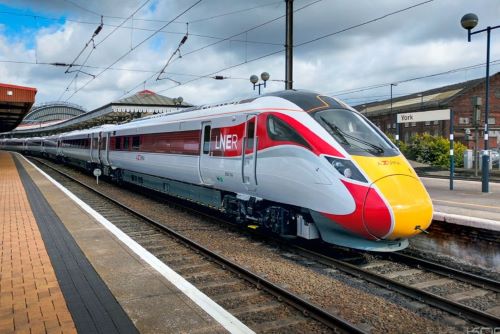
The British Class 800, branded as Azuma on the ECML route, is a part of the Hitachi AT300 product family. It is a bi-mode multiple unit train which can use both overhead electric wires and also has diesel generators to operate on unelectrified track. 23 trainsets from Class 800/1 and 800/2 run for LNER.

AT300 Azuma Class 801/1 + 801/2
Hitachi
2017 – …


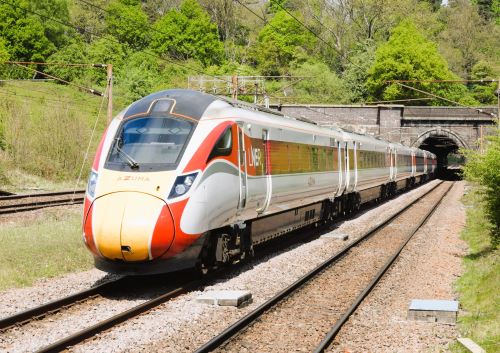
The Class 801 Azuma is a class built by Hitachi Rail for LNER. The units have been in use on East Coast Main Line services since november 2019, as part of the Hitachi AT300 product family. 42 trainsets were ordered and replace gradually the Intercity 225. Unlike Class 800, Class 801 runs only under catenary.


CAF Class …
CAF
… – …


LNER has ordered 10 new 10-car tri-mode trains from CAF, financed by Porterbrook. Based on the Civity platform, they can run on electric, diesel, and battery power. Assembled in Newport, South Wales, they will form the UK’s first tri-mode inter-city fleet, complementing LNER’s Azumas and replacing remaining InterCity 225 sets.

Before LNER

The East Coast Main Line (ECML) connects London King’s Cross with major cities such as York, Newcastle, and Edinburgh, as well as extending services further north to Aberdeen and Inverness. The route plays a vital role in linking England and Scotland, serving millions of passengers each year for both business and leisure travel. A third of the UK population lives within 20 minutes of an ECML station. The ECML also carries a significant amount of freight. In 2019, 58 million tonnes of freight was carried out.

Since privatisation in 1996, four operators managed ECML services during 21 years, alternating between private and public management:

1. GNER (Great North Eastern Railway, 1996–2007): The first private operator under the franchising system, GNER, ran ECML services starting in April 1996. It operated long-distance services between London King’s Cross and destinations such as Leeds, York, Newcastle, and Edinburgh. GNER was noted for high-speed services using InterCity 125 and 225 trains.

2. National Express East Coast (NXEC, 2007–2009): After GNER’s franchise was not renewed due to financial difficulties, National Express took over in December 2007. NXEC continued similar services but struggled with its financial commitments, leading to early termination.

3. Directly Operated Railways / East Coast (2009–2015): When NXEC exited, the government created a publicly owned operator of last resort, Directly Operated Railways, running services under the East Coast brand. This period focused on stabilizing operations and improving performance before re-franchising.

4. Virgin Trains East Coast (VTEC, 2015–2017): The franchise returned to private operators when Stagecoach (90%) and Virgin (10%) won the bid. VTEC ran services under the Virgin Trains East Coast brand.

In addition, since 2000, there has been the presence of the private open access operator Hull Train, a subsidiary of First Group. This operator only operates on part of the ECML.

The end of the franchise system on the ECML

In May 2018, the Theresa May conservative government suspended the franchise Virgin Trains East Coast, because in 2017 Virgin and Stagecoach admitted they could not meet the £3.3 billion premium payments due over the contract’s life. Chris Grayling (the then Secretary of State for Transport from 2016 until 2019), later confirmed the venture had breached a financial covenant, resulting in early termination. The operators reportedly lost around £200 million but paid £1 billion to the government during their tenure.

The government holding company DOHL therefore took over the entire franchise, renaming it LNER after one of the former companies that operated on this line until the creation of British Railways in 1947.

According BBC, a report from VTEC said the route had experienced a 5% growth in passenger numbers in recent months, building on the 21.8 million journeys taken in 2017/18, up 1.3 million from when the franchise began. Stagecoach chief executive Martin Griffiths said the company’s staff could be “fiercely proud of everything they’ve achieved. The growth we’re now seeing proves our initiatives are paying off and the railway we hand over to LNER is not only better than we inherited, but one that has been positively transformed for customers,” he said.

Virgin Trains East Coast (VTEC) managing director David Horne rejoined LNER in the same role, despite being in charge of Virgin East Coast when the contact was terminated three years earlier than planned due to funding issues. All VTEC staff were transfered to the new public operator. In an interview with the Press Association, Mr Horne stressed that he “was not involved” in the 2013/14 bidding process and only joined VTEC at the beginning of 2015.

David Horne praised the customer service performance of VTEC under his leadership. He pointed out that VTEC has the highest passenger satisfaction score among long distance operators in the Transport Focus autumn 2017 report.

The coming of a state company

As a publicly owned company, LNER operates differently from its private predecessors. Its profits are returned to the Treasury rather than shareholders, and its mission includes reinvesting in service quality, sustainability, and innovation. The company places strong emphasis on customer care, community engagement, and digital transformation—introducing features like improved online ticketing, mobile boarding, and real-time service updates. LNER’s commitment to service excellence has earned it consistently high passenger satisfaction ratings, reportedly reaching over 90 percent in national surveys.

LNER continued the long tradition of fast, comfortable rail travel along this corridor, but with a renewed focus on modernisation, reliability, and passenger satisfaction. Most of the planned service improvements went ahead, by taken account of the state of Network Rail’s infrastructure at the time, where some planned works weren’t undertaken, in terms of capacity.

Among the anecdotes, on 12 July 2018, the British Parliament informed us that the cost of advertising connected with brand awareness and the launch of London North Eastern Railway (LNER) was approximately £936,000, which includes print, radio and digital marketing. This activity was critical to ensure that customers were aware that the change from Virgin Trains East Coast to LNER would not involve any disruption to services and that the change did not lead to any loss of revenue. This level of marketing spend is comparable with that of other normal intercity train operators.

LNER revival: nostalgia or practical reform?
In his commentary, Chris Grayling revives the brand name London and North Eastern Railway (LNER) as the government-operated successor of the failed franchise on the East Coast mainline, suggesting it will invoke the “iconic” railway past. But columnist Ian Jack argues in The Guardian this appeal to nostalgia is misleading. He recounts the historical LNER’s constrained performance—burdened by inherited debts, industrial decline in its northern territory and persistent losses—despite its celebrated reputation for speed and style.

Ian Jack suggests Grayling’s move is more about marketing than meaningful reform: invoking a heritage brand without addressing structural issues such as franchise over-bidding, uncertain funding and a lack of clarity about when and how the line will be handed back to private or quasi-public management. He contends the public simply “want the railway to work,” not to become a token for ideological battles about nationalisation or privatisation.


2019

A major development for LNER has been the introduction of the “Azuma” fleet, built by Hitachi. These trainsets, which began entering service in 15 May 2019, have transformed the passenger experience with improved efficiency, reduced journey times, and greater comfort. LNER has significantly benefited from the UK government’s Intercity Express Programme (IEP), which funded the purchase of new trains from Hitachi. The IEP aimed to replace aging InterCity 125 and 225 fleets with modern, faster, more reliable, and energy-efficient trains. For LNER, this meant access to state-of-the-art rolling stock without bearing the full upfront capital cost, improving service quality, passenger comfort, and operational efficiency.


The trains supplied under IEP include the Hitachi Class 800 and Class 801 fleets. Class 800 units are bi-mode trains capable of running on both electric and diesel power, providing flexibility across partially electrified routes, while Class 801 units are pure electric trains optimized for faster, lower-emission operations. The IEP trains feature modern interiors, Wi-Fi, air conditioning, and enhanced accessibility, helping LNER attract passengers and compete effectively with air and road transport.

Under the IEP, LNER currently operated 66 Class 800/801 trainsets, comprising a mix of 9-car and 5-car sets configured for intercity travel along the East Coast Main Line.


2020

During the COVID-19 pandemic, London North Eastern Railway (LNER) faced major disruption as travel demand collapsed due to lockdowns and restrictions. Services were significantly reduced, and strict health measures were introduced, including enhanced cleaning, social distancing, and mandatory face coverings. The company operated under government funding through the Emergency Measures Agreement, ensuring continuity of essential rail services despite revenue losses. LNER focused on supporting key workers and later adapted to fluctuating passenger levels. The crisis accelerated digital innovations such as e-tickets and contactless travel.

On June 26, 2020, the Department for Transport (DfT) confirmed that LNER will continue operating InterCity East Coast (ICEC) services between London, Leeds, and Edinburgh for three more years from June 28, with an option to extend for an additional two years.

While Britain was still living under the rules of the European Union (which it left in January 2021), the direct award contract allows flexibility under EU Regulation 1370/2007, enabling LNER to adapt to changing circumstances. LNER Managing Director David Horne described the agreement as the start of a “new five-year business plan,” emphasizing the ability to adjust commitments in response to short-term pandemic effects while pursuing long-term opportunities.

Robin Gisby, DfT OLR Holdings Executive Director, highlighted that the contract reflected uncertainties in rail demand and infrastructure delays. LNER planned to expand its fleet with Class 80X trains while still retaining some IC225 units for resilience, though passenger restrictions and distancing guidance remained constraints on operations.

2021

Cracks were found in the lifting points—aluminium blocks beneath Class 800 trains used for depot lifting—prompting the withdrawal of all 182 Class 800, 801, and 802 trains operated by GWR, LNER, TransPennine Express (TPE), and Hull Trains on May 8 for inspection. While not used during operation, there is a small risk the blocks could dislodge. The disruption had an impact on passengers travelling or expecting to do so using the services of these train operators. LNER operated 13 nine-car and 10 five-car class 800 bi-modes as well as 30 nine-car class 801 EMUs and 12 five-car class 801 EMUs.

Despite these technical incidents, CEO David Horne stated in August that on LNER passenger numbers over the past three weeks have been back up to 94 per cent of pre-Covid levels. “Our figures reveal that the number of people taking an LNER train for leisure is actually significantly higher than it was pre-Covid. Plenty of us are making up for time lost during lockdown, taking trips to meet up with family and friends we have been unable to see for a long time, or to take a trip this summer to explore somewhere new“, explained the CEO.

With traditional commuting patterns probably changed for ever by the pandemic, many more train journeys now involve an active choice. In response, “our choice as a train company is to change how we think. Over the past 16 months, we have grasped hold of every opportunity to innovate, invest and improve for the benefit of our customers and those who are yet to travel with us for the first time.

In October, a new report by Steer was presented and found that London North Eastern Railway (LNER) can play a central role in the UK Government’s net zero ambitions and levelling-up agenda. The UK Economic, Social and Environment Value Delivered by London North Eastern Railway, by Steer, establishes that LNER services and investment are worth £2bn to the UK every year, and that for every £1 spent running and investing in LNER services, at least £2 is generated in economic (GVA) impact and an additional £0.83 is generated in wider societal impacts. 

The value to the UK of the time saved by customers taking LNER services, and productive time enjoyed by customers on these services, is estimated to be around £610m per year. The economic impact is also felt across the country as LNER’s supply chain adds more than £665m to local economies, from businesses ranging from creative services to cleaning.       

Competition on the same route
In May 2016, FirstGroup won a 10-year agreement from the ORR to operate five daily London–Edinburgh trains via Stevenage, Newcastle, and Morpeth from 2021. Its subsidiary, initially named East Coast Trains, was designed as a low-cost, single-class operator inspired by models like Ouigo and Avlo, aiming to shift air travellers—who make two-thirds of London–Edinburgh journeys—to rail. Offering average fares under £25, free Wi-Fi, and catering, it leased five five-car Hitachi Azuma trains, adapted for single-class use. In September 2021, the service was officially branded Lumo, representing “luminosity in motion.” Lumo began operations on 25 October 2021, initially running two daily services before expanding to a full schedule in early 2022.
See our dedicated page


Side by side at London King’s Cross station, two Hitachi trains: the first from the new operator Lumo, the second, called ‘Azuma’, from LNER (photo Markus Mainka via Shutterstock)

2023

LNER has placed an order with CAF for ten new 10-car tri-mode trains, based on CAF’s Civity platform. These trains—assembled in Newport, South Wales—feature electric, battery and diesel modes, allowing operation on both electrified and non-electrified routes while reducing emissions and noise. The contract also includes an 8-year maintenance agreement, and the trains will be fitted with ETCS signalling to support digital rail upgrades. The new fleet will complement LNER’s existing trains, helping it reach its goal of cutting emissions by 67 % by 2035 and achieving net-zero by 2045.

The same year, LNER, Agility Trains and Hitachi Rail have signed a “Relationship Charter” defining how they will collaborate over the remaining 23 years of the contract supplying and supporting the Azuma fleet on the East Coast Main Line. The original contract was awarded in 2014 under the Intercity Express Programme for 65 Hitachi trainsets, to be used until August 2046. The Charter outlines four areas of cooperation: strategic, tactical, operational and interpersonal – focusing on continuous communication, shared resources, mutual respect and cross-discipline culture. LNER suggested that such Charters may become an industry standard and may be extended to other supplier relationships.

The timetable saga of ECML
The East Coast Main Line (ECML) carrying over 20 million passengers a year connecting London to Scotland. The line connects the capitals of England and Scotland via Yorkshire, York, Durham and Newcastle. The ECML’s timetable is constrained by mixed high-speed and freight traffic, limited double-track sections and junction bottlenecks, legacy signalling and station platform limits, scarce train paths, speed differentials, maintenance windows, and complex timetable interactions—producing path conflicts, low resilience and frequent knock-on delays between Edinburgh and London and limited recovery time. Like all operators, LNER is faced with these capacity constraints, which affects its annual timetable.

For many years ECML benefits of a huge £1.2bn upgrade as part of the national Railway Upgrade Plan including the King’s Cross remodelling project and East Coast upgrade which will see the replacement of signalling, overhead line equipment and a new track layout – reducing journey times, creating up to 10,000 extra seats a day for passengers.

The ECML is therefore seeking to develop a timetable that provides greater capacity. A working group was established within Network Rail, and the implementation of the new timetable began in mid-December 2025.


2024

LNER is launching a two-year trial beginning 5 February 2024, in which fares on the key East Coast Main Line will be simplified. The aim was to better reflect demand across different times of day and to smooth usage by incentivising travel during quieter slots. The revamped structure was intended to boost passenger numbers by making pricing simpler and more flexible, replacing a more complex legacy fare system.

2019-2026: one secretary of state per year!
It is a mistake to think that political events have no influence on rail industry developments. It is interesting to look back at the list of decision-makers during the turbulent period that followed the pandemic in spring 2020. In the United Kingdom, the rail sector had to deal with six different governments and six different transport secretaries between 2019 and 2025, which did not help stability, as emergency measures were coming to an end and the Great British Railway was slowly being implemented. There were two Johnson governments, and Liz Truss’s government lasted only one month and no one remembers Anne-Marie Trevelyan.
In July 2024, Labour returned to power after a 14-year absence. Their return was marked by the acceleration of the implementation of Great British Railways and by relative hostility towards private operators. LNER, already under public management, did not have too much to fear for its future.

LISTING UK SECRETARIES OF STATE FOR TRANSPORT FROM 2018 TO 2025
Secretary of State Term Duration Government Name Political Party
Chris Grayling Jan 2016 – Jul 2019 May Government Conservative
Grant Shapps Jul 2019 – Dec 2019 Johnson Government I Conservative
Grant Shapps Dec 2019 – Johnson Government II Conservative
20 May 2021: the Williams‑Shapps Plan for Rail report
Grant Shapps – Sep 2022 Johnson Government II Conservative
Anne-Marie Trevelyan Sep 2022 – Oct 2022 Truss Government Conservative
Mark Harper Oct 2022 – Jul 2024 Sunak Government Conservative
Louise Haigh Jul 2024 – Nov 2024 Starmer Government Labour
Heidi Alexander Nov 2024 – until now Starmer Government Labour
Composition: Mediarail.be

2025

In June, LNER has celebrated its seventh anniversary as a publicly owned operator by delivering a record breaking year and setting a new benchmark for what a modern, accountable railway can achieve.

In total, 23.7 million journeys were made in the last rail year, the highest customer numbers ever recorded on the East Coast Main Line for second year in a row and in the first two periods of 2025, the operator has continued to grow, logging the highest journey figures ever.

Passenger numbers were surging, particularly for leisure travel, now four out of five journeys, with Scotland showing strong recovery. LNER’s Flex ticket and single-leg pricing pilots aim to simplify fares and improve flexibility, boosting customer satisfaction. Station improvements include family lounges in York and Edinburgh, better access at Peterborough, and enhanced disruption management and mobile connectivity at King’s Cross.

Network Rail worked to punctuality issues, trespass prevention, and climate-related disruptions, while LNER supported driver wellbeing in response to trauma incidents. Significant station upgrades were undertaken. Bradford Forster Square’s new Platform 0, ready in May 2025, supported increased services for the city’s 2025 City of Culture celebrations. In Darlington, two new platforms, a step-free footbridge, and a £140 million station overhaul were finish by autumn 2025.

In October, LNER launched a new WhatsApp broadcast channel offering passengers real-time travel information, service updates and disruption alerts—even if they booked via other platforms. Notifications are off by default and users can enable or disable them as needed.

Now the most important development was the introduction of a new timetable on the East Coast, which benefited LNER. 🟧


Share this page   
Follow Us on    Follow Us on       

[TOP]
Main line • Intercity • Great-BritainLexical

——————————————————————————————————————————————————————————————-